|
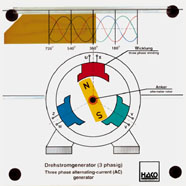
Order No. 174
Three-phase alternating-current (AC) generator
-
when the rotor turns, three different and phase-displaced AC
voltages are produced. These voltages correspond with the
colours of the electromagnets
- the sinusoidal oscillation is at its
positive maximum when the rotor's North Pole reaches the
electromagnets, and at its negative maximum when the rotor's
South Pole reachs the electromagnet
|
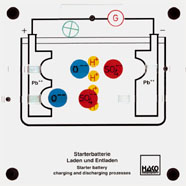
Order No. 167
Charging a battery
-
discharged battery; charging procedure; charged battery;
discharging the battery
- generator or consuming device can put
into the electric circuit
|
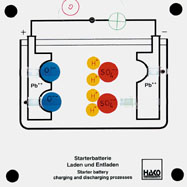
-
all chemical procedures can be shown by moving molecules and
atoms
|
|
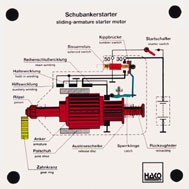
Order No. 262
Sliding-armature starter motor
Functions:
- operating the starter switch
- pulling the tumbler switch to one side
|
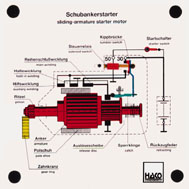
Parked position:
- selecting the first shifting stage
- displacement of the entire armature
- the catch is released by the armature
|
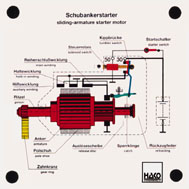
Engaging the pinion
- selecting stage 2 by means of the tumbler
switch
- function of the retracting spring
|
|
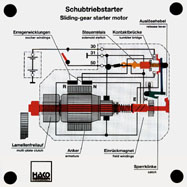
Order No. 312
Sliding-gear starter motor
- at rest position
- actuating the starter switch
- actuating the solenoid switch
|
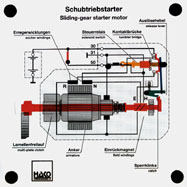
-
closing the bypass windings
- function of the tumbler bridge
- engaging the pinion
|
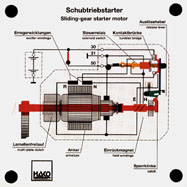
- lifting the catch using the release lever
- connecting the bypass windings
|
|
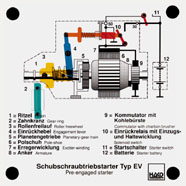
Order No. 142
Starter motor
(pre-engaged drive starter with planetary gear by BOSCH)
- starter switch can be moved, the solenoid switch is closed
- activating the excitation winding,
engaging the pinion
- function of the spring when tooth touches
tooth
|
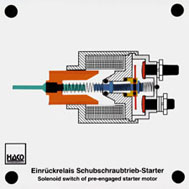
Order No. 450
Solenoid Switch of pre-engaged starter motor
-
Function of pull-in and holding winding
- Pulling of the armature when current
flows
|
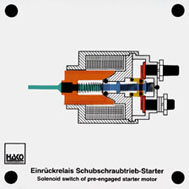
-
Closing the contacts by the contact bridge
- Function and interaction of the springs
|
|
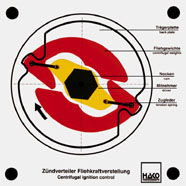
Order No. 140
Centrifugal advance device of a distributor
- function of the centrifugal weights
- function of the retracting spring
- ignition advance caused by centrifugal
weights acting on the contact-breaker cam
|
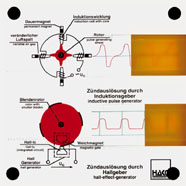
Order No. 184
Pulse generation
(made-up of two models)
a) induction-type pulse generator
b) hall-effect pulse generator
The oscilloscope display for the pulse
generation is produced by turning the rotor or the rotor with
shutter blades.
|
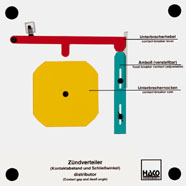
Order No. 138
Ignition distributor
-
opening and dwell angle can be read
- change of the breaker-point gap
- opening and dwell angle change depending
on the breaker-point gap
|
|

Order No. 139
Vacuum advance at an ignition distributor
-
rotating of the contact-breaker plate by the vacuum box
- ignition advance
- the ignition interval can be changed -
there are cams for four and six cylinders
|
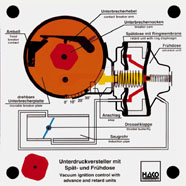
Order No. 230
Ignition distributor with advanced and retarded ignition
- in addition, the functions of advanced and retarded ignition
can be shown and the interaction of both ignition-timing systems
can be seen
(All parts can be moved and are equipped
with real steel springs and diaphragms).
|
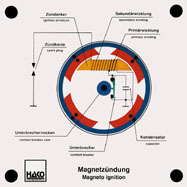
Order No. 330
Magneto ignition
-
function of the contact breaker
- function of the pole wheel with permanent
magnets
- magnetic field layout
- high-voltage generation
- function of the condenser
|
|
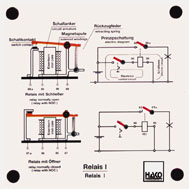
Order No. 273
Relay I
the following can be shown:
- difference between normally closed
contacts (NCC) and normally opened contacts (NOC)
- function of the NCC and NOC relay
- motion of the circuit armature is shown
on relay model
- motion of the circuit armature in the
electric diagram
|
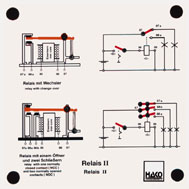
Order No. 274
Relay II
Functions:
- motion of the circuit armature is shown
on relay model
- motion of the control switch in the
electric diagram
|
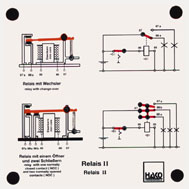
-
motion of the circuit armature in the electric diagram
- selecting different electric circuits
|
|
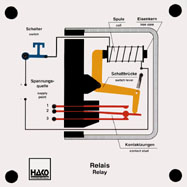
Order No. 341
Relay III
When the switch is actuated the jumper is drawn to the solenoid
coil by means of a transparent cam plate. Simultaneously, the
jumper switches ...
|
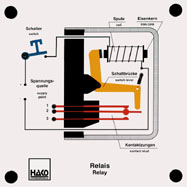
... the contacts of electric circuit 2-1 over to circuit 2-3.
|
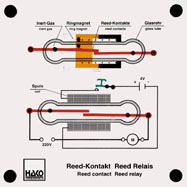
Order No. 357
Reed contact relay
- function of the ferric magnets
- function of the magnet coils
- opening and closing of the reed contacts
- application of the reed contacts and of
the reed relay in automotive engineering
|
|
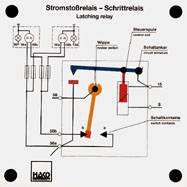
Order No. 300
Latching relay
-
pulling the circuit armature
- actuating the rocker switch
- rocker switch in contact positions
|
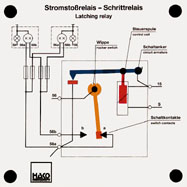
- switching to full beam or dipped headlights
|
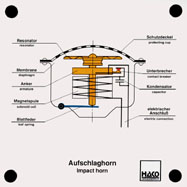
Order No. 333
Impact horn
- magnetic field layout
- armature stroke against iron coil core
- resonator movement
- CI interruption and connection of the
electric circuit
- function of the leaf spring
|
|
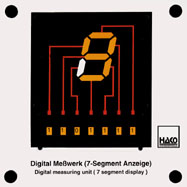
Order No. 344
Digital Measuring Unit I
-
method of functioning of a digital measuring unit
- control via a 7-character binary word
- formation of the numbers 0-9 and some
letters
...
|
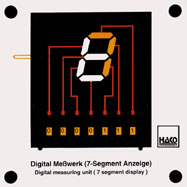
... (by
the simple sliding of the windows of controlled segment and of
the binary numbers in the field of vision)
|
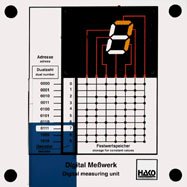
Order No. 345
Digital Measuring Unit II
Conversion of the binary number at the input of the
decoder into a decimal number on the display. Control of the
one-character seven-segment display via the constant memory (by
moving the field of vision and sliding the illuminated window of
the controlled segments).
|
|
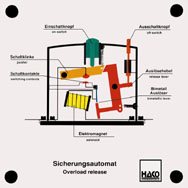
Order No. 340
Overload release
- power flow in overload release
- release caused by overload
- thermal release
|
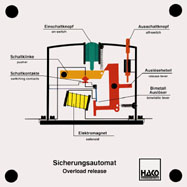
- manual release
- power flow recovery after release
|
|
|
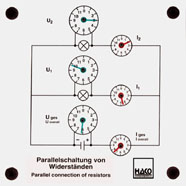
Order No. 241
Parallel connection of resistors
Flow of current and voltage when using a parallel connection of
resistors can be shown by means of three voltmeters and three
ammeters.
|
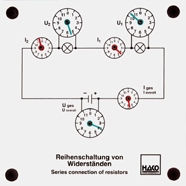
Order No. 242
Series connection of resistors
Flow of current and voltage when using a series connection of
resistors can be shown by means of three voltmeters and three
ammeters.
|
|
|
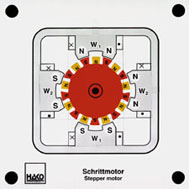
Order No. 452
Stepper motor
-
Mode of effect of a stepper motor
- Polarity reversal of windings 1 and 2
|
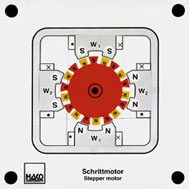
-
Change of the poles of the magnetic fields
- Movement of the impeller
(steps turning left or right)
|
|
|
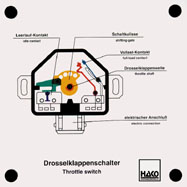
Order No. 336
Throttle switch
- closing of the idle contact with idling position and trailing
throttle
- closing of the full-load contact with
full-load operation
|
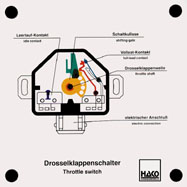
- opening of the idle contact and of the full-load contact with
part load operation
|
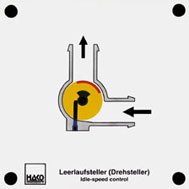
Order No. 444
Idle-speed control
- Task of the rotary actuator
- Function of the rotary valve
- Normal function, emergency operation
function
|
|
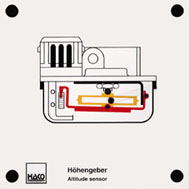
Order No. 453
Altitude sensor
With the help of a lever on which there is a cam, the
altitude capsule can be spread and one sees
how the
red lever is moved and the sensing on the
resistance
path of the potentiometer is displaced. The
altitude
sensor reports the alteration in air
pressure compared
with the loading pressure regulation to the
control
device and leads to a correction of the
amount injected.
|
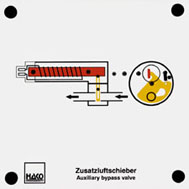
Order No. 443
Auxiliary bypass valve
- The additional air slide as a bypass
- Function of the bimetal
|
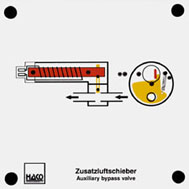
If the engine speed is too low, the cross-section is reduced,
the output rotor turns more quickly.
|
|
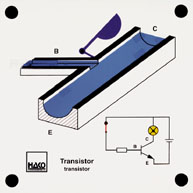
Order No. 427
Transistor
The base is actuated by closing the switch. The collector
emitter line becomes conductive, the lamp lights up. This can be
shown clearly with the help of the water analogy. When the small
flow of water ...
|
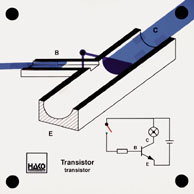
... reaches the base, this flow of water opens the slide and
makes the way free for the large water flow (collector emitter
line), the water can flow.
|
|
|
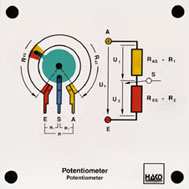
Order No. 441
Potentiometer
- Mode of effect of a potentiometer
- Wiring diagram of a potentiometer
|
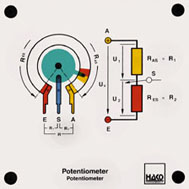
- Function of the sliding contact
- Function as a power divider
|
|
|
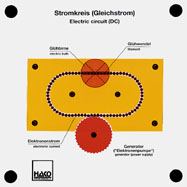
Order No. 313
Electric Circuit (DC)
The model shows how the generator (electron pump) actuates the
electrons in the wire. In the electric bulb the electrons are
slowed down (line restriction). Thus friction heat and light are
produced.
Simulation:
- DC: The electrons move in one direction
only
- AC: The electrons are moved back and
forth
|
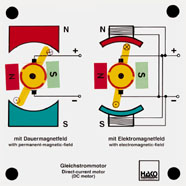
Order No. 162
Commutator
-
principle of a direct-current (DC) motor and a commutator
- the magnetic field turns with the
electromagnet; after 180 degrees, the current direction changes
|
|
