CE,

   Basic Operation Principle

  CEK Fluid Mixing Studies - Issue 8

Download For more details
 
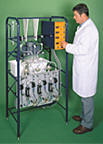
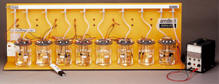
The Armfield Fluid Mixing Apparatus has been developed to demonstrate the factors affecting mixing using visualisation and measurement techniques as appropriate. It is suitable as an instructional aid or as a design tool for large scale mixers.


  CEL Fixed and Fluidised Bed Apparatus - Issue 9

Download For more details
 
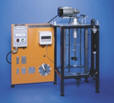
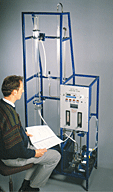
The apparatus is designed to facilitate the study of flow through fixed and fluidised beds of solid particles. Provision is made for the simultaneous study of air and water systems in order to demonstrate the difference between 'aggregative' and 'particulate' fluidised bed characteristics. Students can readily observe the important phenomenon of 'bubbling'.


  Solids Handling Studies CEN mkII - Issue 1

Download For more details
 
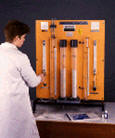
The flow and handling characteristics of granular materials are relevant to many process industries, particularly in the handling of powders, pellets, crystals and aggregates. The CEN-mkII introduces students to the behaviour of granular materials and is available as three units that can be purchased separately or as acomplete set.


  CEQ Corrosion Studies Kit - Issue 10

Download For more details
 

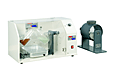
Corrosion represents a significant factor in determining durability and safety of industrial processes. Student engineers need to understand fully the effects of corrosion and how these can be anticipated and prevented. The Armfield Corrosion Studies Kit is designed to provide an introduction to this topic and allows students to recognise potentially corrosive situations and develop information to permit the selection of adequate materials.


  CERa/CERb Mass Transfer and Diffusion Coefficients - Issue 10

Download For more details
 
Two separate items of laboratory equipment have been designed to allow measurement of molecular diffusivities and, in so doing, to familiarise students with the basic notions of mass transfer theory. The gaseous diffusivity apparatus (CERa) involves diffusion with bulk flow, whilst the liquid diffusivity apparatus (CERb) relates to an equi-molar counter-diffusion process.


  CES Wetted Wall Gas Absorption Column - Issue 5

Download For more details
 
Wetted wall columns may be used to determine gas/liquid mass transfer coefficients, essential when calculating the design of absorption towers. Such coefficients form the basis of correlations used to develop packed towers. CES examines the absorption of oxygen from air into deoxygenated water (prepared by nitrogen sparging). This is an example of liquid film controlled absorption. The liquid film mass transfer coefficient can be determined at various mass flow rates of water.


  CEU Catalytic Reactors - Issue 2

Download For more details
 
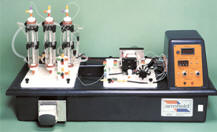
CEU utilises the sugar inversion reaction (Sucrose -> Glucose + Fructose) to study the performance of packed bed chemical and biological catalytic reactors. A colorimetric assay is used to determine the degree of conversion using an optical sensor. Assays may be automated using optional flow injection analysis.


  Plug Flow Reactor – CEY - Laminar Flow Reactor – CEZ

Download For more details
 
Two new reactor accessories for use with the Armfield CEX Chemical Reactors Service Unit. These reactors demonstrate flow patterns and reaction rates. They can be used as highly visual flow demonstration techniques, but also include the instrumentation for performing analysis of the reactions and comparing the progress of the reactions with the theory.
The CEY demonstrates step and pulse changes for Plug flow characterisation and steady state conversion for a second order reaction.

The CEZ demonstrates step change for Laminar flow characterisation and steady state conversion for second order reaction.


  Plug Flow Reactor – CEY - (Laminar Flow Reactor – CEZ)

Download For more details
 
Two new reactor accessories for use with the Armfield CEX Chemical Reactors Service Unit. These reactors demonstrate flow patterns and reaction rates. They can be used as highly visual flow demonstration techniques, but also include the instrumentation for performing analysis of the reactions and comparing the progress of the reactions with the theory.
The CEY demonstrates step and pulse changes for Plug flow characterisation and steady state conversion for a second order reaction.


  CEXC Chemical Reactors Teaching Equipment - Issue 1

Download For more details


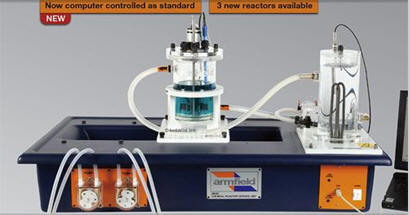
Unique New Computer Controlled Equipment
- More Reactor Types
- Improved Features
- Transparent Batch reactor
- Open ended for project work

The Armfield CEXC family is a range of chemical reactors specifically developed for the teaching and demonstration of types of chemical reactor to Chemical Engineering students. Real chemical reactions take place within the reactors, and Armfield have developed a number of representative reactions which are easy and safe for students to use in the laboratory environment.
   

UOP

   Heat & Mass Transfer Unit Operations

  Distillation Engineering Teaching Equipment
  UOP3 Distillation Columns - Issue 6

Download For more details
 
Considerable advances in the instrumentation and control of distillation columns have been made in recent years, prompted by the advent of computer-linked systems supported by software packages for handling plant operating data. To reflect these advances, Armfield has developed two new state-of-the-art laboratory-based distillation columns that allow safe hands-on practical training for student engineers and plant operators:-

• A continuous or batch operation, computer-compatible column (model reference UOP3CC) which allows a full range of demonstrations from the introductory stages of a process engineering course through to the more complex demonstrations of modern control strategies.

• A batch-only operated version (model reference UOP3BM) manually controlled, permits comprehensive study of the basic principles of distillation.


  UOP4MkII Solid/Liquid Extraction Unit - Issue 3

Download For more details
 
- CONTINUOUS SOLID/ LIQUID EXTRACTION
- MULTIPLE STAGE
- INDUSTRIAL ROTARY CELL CONFIGURATION
- COMPUTER COMPATIBLE

The UOP4MkII is a laboratory solid/liquid extractor system for teaching the fundamentals of this important Unit Operation to chemical engineering students. The equipment utilises a sophisticated, continuous feed, counter current flow, multiple stage, rotary extractor system of the type frequently seen in industrial applications. This gives the student an insight into the practical implementation of the operation, including process economics and control problems. The effects of temperature, multiple stages, and throughput rate can all be investigated. The extractor is computer compatible with optional educational software.


  UOP5 Liquid/Liquid Extraction Unit - Issue 12

Download For more details
 
Liquid/liquid extraction is a valuable process in chemical engineering where the separation of one or more of the components from a liquid mixture is required. The Armfield UOP5 unit demonstrates this process in the laboratory so that students may gain a thorough understanding of this industrial technique.
Meaningful experiments may be conducted within a two hour laboratory period and students benefit from visual observation of the process.


  UOP6 Basic Water Cooling Tower - Issue 9

Download For more details
 
The Armfield Basic Water Cooling Tower has been designed to give students an appreciation of the construction, design and operational characteristics of a modern evaporative cooling system. The unit is also an excellent example of an 'open system' through which two streams of fluid flow (water and air) and in which there is a mass transfer from one stream to the other.
Convincing energy and mass balances are obtained and students can quickly investigate the effects of:

  >  air flow rate
  >  water flow rate
  >  water temperature
  >  cooling load
  >  packing density
on the performance of a cooling tower.


  UOP7 Gas Absorption Column - Issue 11

Download For more details
 
The Armfield Gas Absorption Column has been designed to demonstrate the principles of gas absorption and to provide practical training in the operation of gas absorption plant.


  UOP8 Tray Drier - Issue 8

Download For more details
 
This small scale tray drier dries solids by passing a stream of hot air over trays of wet material, a method commonly used in industry. The unit is applicable to the Unit Operations laboratory of educational establishments and also to Food Technology education and research.


  UOP10 Laboratory Steam Generator - Issue 7

Download For more details
 
As many laboratories do not incorporate a centralised or reliable steam source, Armfield offers an advanced boiler providing a constant supply of steam. The compact unit requires only connection to water and electrical supplies for operation.


  UOP10 Laboratory Steam Generator - Issue 7

Download For more details
 
As many laboratories do not incorporate a centralised or reliable steam source, Armfield offers an advanced boiler providing a constant supply of steam. The compact unit requires only connection to water and electrical supplies for operation.


  UOP12 Filtration Unit - Issue 2

Download For more details
 
Filtration is an extremely important unit operation being used by industries such as chemical, food and water treatment.

The Armfield filtration unit demonstrates the principles of batch filtration using a fully functional plate and frame filter system. A continuous, tangential flow microfiltration unit using a hollow fibre filtration cartridge (a membrane technology application) is available as an option. Both types of filter are widely used in the commercial world.

The practical training exercises are appropriate to chemical and all other process related engineering courses, including technician training. An economic investigation allows the student to take experimental data and to use it to help make decisions on the size and the operation of a filtration plant in order to meet economic and output targets.


UOP12 WITH THE PLATE AND FRAME FILTER UNIT


  UOP14 Crystallisation Unit - Issue 1

Download For more details
 
Crystallisation is a valuable process in chemical engineering where the separation of one or more of the components from a liquid mixture is required.

The Armfield UOP14 demonstrates this process in the laboratory so that students may gain a thorough understanding of this industrial technique. The UOP14 system demonstrates an industrially important type of crystallisation, namely solution cooling crystallisation.

Meaningful experiments may be conducted within a typical laboratory period and students benefit from visual observation of the process.


  UOP15 Fixed Bed Adsorption Unit - Issue 1 Download For more details
 
UOP15 demonstrates the adsorption of a solute, carbon dioxide, from a binary gas mixture onto the surface of a solid adsorbent, activated carbon. The process takes place in a fixed bed adsorption column. The adsorption and desorption/regeneration processes are monitored using temperature sensors sited at intervals along the column and also by carbon dioxide measurement of the exit gas using an infra red (IR) detector.


  UOP20X Modular Evaporator Series - Issue 4

Download For more details
 
> Rising or Falling Film
> Double or Single Effect
> Steam or Electric Heating
> Computer Data Logging and Control

The UOP20 family is a modular system of teaching evaporators for chemical engineering departments. Using the various modules a wide range of configurations can be implemented: rising or falling film; single or double effect; forward, backward or parallel feed.
The evaporators are fully computer compatible, supplied with educational software including process control and data logging facility, suitable for use with a personal computer.

  Now with NEW USB interface and software